
Acbuy Spreadsheet Shipping Cost Guide: How to Estimate Your Total Order Cost
Learn how to use the Acbuy Spreadsheet Shipping Cost Guide to estimate product costs, domestic delivery, parcel weight, volumetric weight, international shipping, and possible destination charges before ordering.
GoGo Finder
7/16/202610 min read
Introduction
A product’s listed price is only one part of the total cost when buying through a Chinese shopping agent.
A pair of sneakers may look inexpensive on the original marketplace page, but the final amount can also be affected by domestic delivery in China, warehouse services, parcel dimensions, international shipping, exchange rates, and destination-related charges.
This Acbuy Spreadsheet Shipping Cost Guide explains how buyers can estimate the full order cost before submitting a parcel. It does not promise an exact shipping price because rates and available lines may change. Instead, it provides a practical budgeting method that helps users understand where the final cost comes from.
When using the Acbuy Spreadsheet, buyers should think about the complete order rather than evaluating each product only by its marketplace price.
Why the Product Price Is Only the Starting Point
The price shown on a Weidian or another marketplace listing normally represents the cost of the item itself.
It may not include:
Delivery from the seller to the Acbuy warehouse
Optional warehouse or packaging services
International parcel shipping
Payment or currency-conversion differences
Customs duties, import tax, or local handling charges
Final domestic delivery after customs clearance
This means two products with similar listing prices may produce very different final costs.
A lightweight T-shirt and a bulky pair of sneakers may cost the same at the marketplace stage, but their international shipping impact can be very different.
The Acbuy total order cost should therefore be estimated across the full buying process.
The Main Parts of an Acbuy Order Cost
A practical total-cost estimate can be divided into several parts.
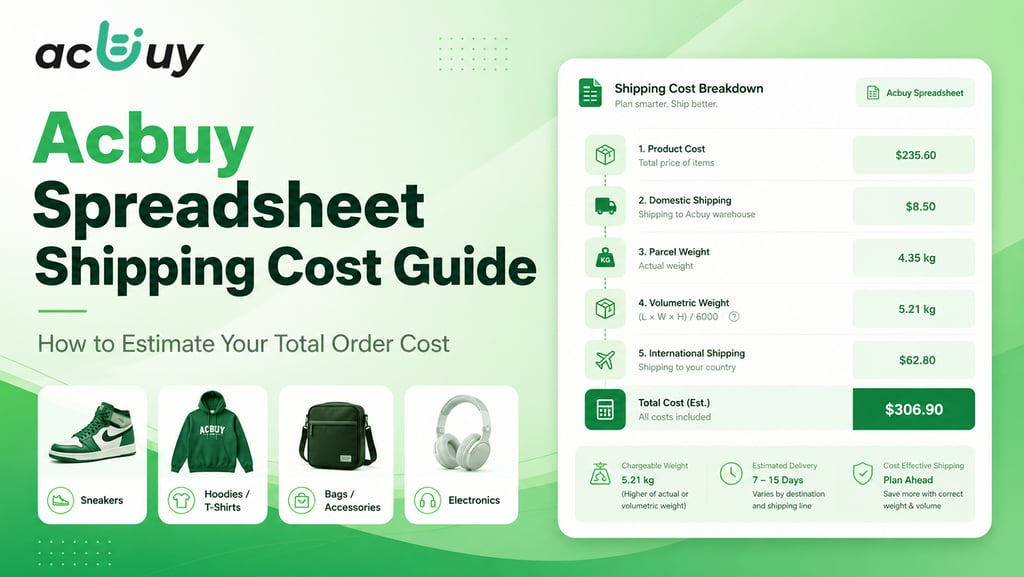
Product Cost
This is the listed marketplace price of the selected item.
Domestic Shipping in China
Some sellers charge for delivery to the agent warehouse, while others may include it or calculate it separately.
Warehouse and Optional Services
Depending on the available options, buyers may choose services related to inspection, packaging, reinforcement, removal of unnecessary packaging, or other parcel preparation.
International Shipping
This is often the largest additional cost. It may depend on actual weight, parcel dimensions, destination, selected line, and current rate rules.
Destination Charges
Some parcels may be subject to import tax, duties, customs processing, or local carrier fees. These vary by destination and shipment type.
Currency and Payment Differences
Exchange rates and payment processing can affect the amount paid in the buyer’s local currency.
A useful budget should account for all of these parts rather than focusing only on the first number shown on the product page.
A Simple Total-Cost Framework
Buyers can think about the order in this way:
Total order cost = products + China domestic delivery + warehouse options + international shipping + possible destination charges
This is a planning framework, not a guaranteed quote.
The exact amount normally becomes clearer after items arrive at the warehouse and the parcel’s actual dimensions and weight are available.
Before that point, the goal is to build a reasonable estimate and identify which products may increase shipping costs.
Actual Weight and Volumetric Weight
One of the most important concepts in this Acbuy shipping cost guide is the difference between actual weight and volumetric weight.
Actual Weight
Actual weight is the physical weight of the packed parcel.
A parcel containing dense products may be relatively small but still heavy.
Volumetric Weight
Volumetric weight reflects how much space a parcel occupies during transport.
A large, lightweight package can be charged based on size rather than scale weight because it takes up more cargo space.
Depending on the shipping line, the carrier may charge using:
Actual weight
Volumetric weight
The higher of the two
Another line-specific calculation method
This is why a large jacket, shoe box, or structured bag may increase shipping cost even when it does not feel especially heavy.
Why Parcel Dimensions Matter
Buyers sometimes estimate shipping only by kilograms and ignore package dimensions.
That can lead to an unrealistic budget.
Parcel size can be affected by:
Shoe boxes
Thick jackets and hoodies
Structured bags
Protective packaging
Multiple product boxes
Electronic-product packaging
Items that cannot be compressed safely
Two parcels with the same actual weight can have different shipping costs if one occupies significantly more space.
When browsing through the Acbuy Spreadsheet, identify products that are likely to be bulky before adding too many of them to the same shopping plan.
How Sneakers Affect Shipping Cost
Sneakers are among the most popular product categories, but they can use considerable parcel space.
The main factors include:
Shoe weight
Shoe-box dimensions
Protective packaging
Number of pairs in the parcel
Whether the boxes are retained or removed
Whether the shoe shape requires extra protection
Removing a shoe box may reduce volume, but this can also reduce protection or affect how the product arrives.
Buyers should decide based on product value, shipping priorities, and the level of protection they need.
Do not assume that removing all packaging is automatically the best option.
How Hoodies and Jackets Affect Shipping Cost
Hoodies, sweaters, and jackets can add both weight and volume.
A thin hoodie may compress easily, while a padded jacket can occupy much more space.
Consider:
Fabric thickness
Lining
Insulation
Garment size
Number of items
Whether compression is suitable
Seasonal parcel demand
Bulky winter clothing may produce a higher volumetric weight than lightweight summer apparel.
Buyers planning several thick garments should leave more room in the shipping budget than buyers ordering only T-shirts or accessories.
How T-Shirts and Lightweight Apparel Affect Cost
T-shirts, thin jerseys, shorts, and lightweight garments are usually easier to combine into one parcel.
They tend to:
Weigh less
Compress more easily
Use less package space
Create fewer packaging complications
However, the total can still grow when many items are combined.
Ten lightweight items may create a meaningful parcel weight even if each item is individually small.
A shopping list should therefore track both individual product size and total quantity.
How Bags and Accessories Affect Shipping Cost
Bags and accessories vary widely.
A soft fabric bag may compress, while a structured handbag or crossbody bag may require shape protection. Jewelry, caps, sunglasses, belts, and small accessories can also require different packaging.
Important considerations include:
Whether the item can be flattened
Whether it contains a hard case
Whether the shape must be protected
Whether multiple accessories can be combined efficiently
Whether the item is fragile
A small accessory is not always cheap to ship if its packaging is large relative to the product.
How Electronics Affect Shipping Options
Electronics may require more careful planning than clothing.
Potential considerations include:
Batteries
Magnetic components
Fragility
Protective packaging
Restricted shipping lines
Destination-specific transport rules
Not every shipping line may accept every electronic product.
Even when the item itself is small, the available route may influence the final cost or delivery time.
Buyers should check current line eligibility and warehouse guidance before assuming an electronic product can be shipped with ordinary clothing.
Should Buyers Consolidate Items into One Parcel?
Consolidation means combining multiple warehouse items into one international parcel.
This can be useful because certain basic shipping costs may be spread across several products. It can also make order management easier.
However, a larger parcel is not always automatically better.
A consolidated parcel may:
Become heavier
Produce a higher volumetric weight
Exceed a preferred line’s limits
Contain mixed product types
Require more complex packaging
Increase the value exposed in one shipment
The right decision depends on parcel composition, line rules, destination, and buyer priorities.
When Splitting a Parcel May Make Sense
Splitting may be worth considering when:
One product is unusually bulky
Electronics have different line requirements
The full parcel exceeds a preferred weight range
Certain items need stronger protection
The buyer wants to separate high-priority products
A large parcel creates inconvenient dimensions
Splitting can also increase cost because each parcel may have its own minimum or starting charge.
There is no universal rule that one parcel or multiple parcels are always cheaper.
The best approach is to compare the available shipping estimates after warehouse measurements are known.
How to Build a Shipping Budget Before Ordering
The most useful time to think about shipping is before buying too many products.
Use the following workflow.
Step 1: Create a Product Shortlist
Browse the Acbuy Spreadsheet and save the items you are seriously considering.
Do not count every interesting product as a confirmed purchase.
Step 2: Group Products by Category
Separate sneakers, lightweight clothing, bulky clothing, accessories, and electronics.
This makes likely shipping impact easier to understand.
Step 3: Mark Bulky or Restricted Items
Pay special attention to:
Shoe boxes
Thick jackets
Structured bags
Fragile accessories
Battery-powered electronics
Large original packaging
Step 4: Set a Product Budget and a Shipping Budget
Do not spend the full available budget on products.
Reserve a separate amount for:
China domestic delivery
Warehouse preparation
International shipping
Possible destination charges
Step 5: Keep Optional Items Separate
Mark some products as lower priority.
If the projected order becomes too large or expensive, these items can be removed before purchase.
Step 6: Review the Parcel After Warehouse Arrival
Once the warehouse provides actual product data, review the likely parcel weight, dimensions, and suitable lines before submitting international shipping.
This Acbuy Spreadsheet parcel-planning workflow reduces the chance of discovering too late that the order is more expensive to ship than expected.
Why Buyers Should Avoid Exact Shipping Claims Too Early
Before a product reaches the warehouse, shipping estimates may be incomplete.
Marketplace listings do not always provide reliable packed weight or dimensions. Sellers may use different packaging, and the warehouse may measure the final item differently from an early estimate.
Actual cost can also change because of:
Updated carrier rates
Seasonal surcharges
Fuel-related changes
Line availability
Destination restrictions
Parcel dimensions
Packaging choices
This is why responsible shipping guidance should use estimated ranges and clear assumptions rather than guaranteed prices.
The final quote shown during parcel submission is more important than an early guess.
How Coupons Affect the Final Cost
Coupons can reduce some costs, but they should not be treated as a reason to buy unnecessary products.
A coupon may have:
A minimum-spend requirement
An expiration date
A specific use category
A maximum discount
Shipping-line restrictions
New-user limitations
A discount does not always offset the additional shipping caused by adding another bulky item.
The better strategy is to apply coupons to an order that already makes sense.
Do not increase the parcel size solely to reach a promotion threshold unless the added item is genuinely useful and the total cost remains reasonable.
Product Price vs Landed Cost
The marketplace price answers one question:
How much does the seller charge for the item?
Landed cost answers a broader question:
How much does it cost to receive the item at the final destination?
Landed cost may include:
Product price
Domestic shipping
Agent-related costs
International shipping
Destination tax or duty
Local delivery or carrier charges
For international buyers, landed cost is the more useful number.
An inexpensive product can become poor value if it is unusually bulky or difficult to ship. A slightly higher-priced product may produce better overall value if it is easier to package and fits the existing parcel.
Regional Considerations for United States Buyers
Buyers in the United States should consider:
Current shipping-line availability
Delivery speed differences
Carrier handoff after arrival
Customs declarations
Possible state or carrier-related charges
Parcel size and route restrictions
Shipping conditions can change, so buyers should review the options displayed during parcel submission instead of relying only on an old rate shared online.
Regional Considerations for United Kingdom Buyers
UK buyers should consider:
Import VAT treatment
Customs declaration values
Carrier processing
Line-specific delivery methods
Possible handling charges
Parcel tracking after entry
The exact treatment can depend on shipment details and current rules.
Use the latest checkout, carrier, and official customs information when estimating the final amount.
Regional Considerations for European Union Buyers
EU buyers should consider:
Destination-country VAT
Customs processing
IOSS or line-specific tax handling where applicable
Local carrier fees
Different rules among EU member states
Delivery handoff and tracking
A shipping method suitable for one European destination may not be identical for another.
Avoid assuming that all EU countries have the same cost or delivery experience.
Regional Considerations for Canada
Canadian buyers may need to account for:
Long-distance domestic delivery after import
Duties or taxes
Carrier handling fees
Available line restrictions
Regional differences in final delivery
The lowest international rate may not always produce the best overall delivery experience.
Compare service type, tracking, and estimated delivery alongside the price.
Regional Considerations for Australia and New Zealand
Buyers in Australia and New Zealand should consider:
Distance-related transport costs
Line availability
Battery or electronic restrictions
Customs and tax treatment
Final-mile delivery time
Remote-area delivery differences
For distant destinations, parcel efficiency can become especially important.
Removing unnecessary volume may have a meaningful impact when the selected line uses volumetric charging.
Common Shipping Budget Mistakes
Spending the Entire Budget on Products
This leaves no room for international shipping or destination costs.
Assuming All Products Ship by Actual Weight
Some lines may use volumetric calculations.
Ignoring Shoe Boxes and Packaging
Packaging can significantly increase parcel size.
Buying Too Many Bulky Items Together
Several thick or structured items can create a large parcel quickly.
Treating a Coupon as Guaranteed Savings
A discount may not compensate for extra parcel weight or volume.
Submitting the Parcel Too Quickly
Wait until all intended items are available and review the parcel plan carefully.
Using Outdated Rate Examples
Shipping rates, line rules, and surcharges may change.
Ignoring Destination-Specific Rules
Taxes and carrier practices vary by country and region.
How to Compare Shipping Lines
When available lines are shown, do not compare only the headline price.
Review:
Accepted product types
Actual or volumetric charging method
Estimated delivery time
Tracking quality
Parcel-weight limits
Size restrictions
Tax-handling information
Insurance or compensation terms
Destination coverage
A cheaper line may be unsuitable for the product category or provide a slower delivery experience.
A more expensive line may offer better tracking, fewer restrictions, or a more convenient delivery method.
The right choice depends on the buyer’s priorities.
Packaging Choices and Their Trade-Offs
Packaging changes can reduce size or improve protection.
Possible options may include:
Removing external shoe boxes
Folding or compressing clothing
Keeping original packaging
Adding corner protection
Reinforcing the parcel
Using protective wrapping
Separating fragile items
Every change involves a trade-off.
Removing packaging can reduce volume but may provide less protection. Reinforcement can improve protection but add weight and size.
Choose packaging based on the product, not only the cheapest possible rate.
Insurance and Risk Planning
International transport carries some level of risk.
Where insurance or compensation options are available, buyers should review:
Covered events
Declared-value limits
Excluded product types
Required evidence
Claim deadlines
Packaging conditions
Insurance should not be assumed to cover every problem automatically.
Buyers shipping higher-value products may decide that additional protection is worth the cost, while low-value parcels may be handled differently.
The choice depends on parcel value and personal risk tolerance.
A Practical Example Without Fixed Rates
Imagine a buyer selects:
One pair of sneakers
Two T-shirts
One hoodie
One crossbody bag
One pair of headphones
The sneakers and their box may use considerable space. The hoodie adds volume. The bag may need shape protection, and the headphones may restrict available shipping lines.
Before ordering, the buyer should:
Separate essential and optional products
Decide whether the shoe box is important
Check whether the headphones can use the preferred line
Reserve a meaningful shipping budget
Wait for warehouse measurements
Compare consolidation and split-parcel options
Review possible destination charges
This is more useful than assuming the parcel will cost a fixed amount per kilogram.
Final Parcel Checklist
Before submitting international shipping, confirm:
Are all intended products in the warehouse?
Did I check the actual parcel weight?
Did I review the parcel dimensions?
Is the line using actual or volumetric weight?
Are all product categories accepted?
Do I need original boxes?
Have I removed unnecessary packaging only where appropriate?
Did I compare at least two suitable shipping options?
Did I review destination tax or customs considerations?
Is the declared information accurate?
Do I need insurance or extra protection?
Am I satisfied with the final total before payment?
If several answers are unclear, pause before submitting the parcel.
Why Better Parcel Planning Improves the Acbuy Experience
Good parcel planning helps users:
Avoid unexpected shipping costs
Compare products based on total value
Keep product and shipping budgets separate
Select categories more carefully
Reduce unnecessary packaging
Choose suitable shipping lines
Make better use of coupons
Build more efficient future orders
Over time, buyers can keep notes about which product categories created the most weight or volume.
This makes future Acbuy Spreadsheet shipping estimates more realistic.
Final Thoughts
The Acbuy Spreadsheet Shipping Cost Guide helps buyers understand that product price and final order cost are not the same.
A realistic budget should consider the product, China domestic delivery, warehouse preparation, international shipping, parcel dimensions, payment differences, and possible destination charges.
Actual weight matters, but parcel volume can be equally important. Sneakers, thick clothing, structured bags, and electronics may affect the available lines and the final shipping total in different ways.
Use the Acbuy Spreadsheet to build a focused shopping list, identify bulky products early, and reserve a separate shipping budget. Once the products reach the warehouse, compare the measured parcel data and available lines before submitting international delivery.
Better planning does not guarantee the lowest possible cost, but it can reduce surprises and help buyers make more informed decisions.
→ Explore Acbuy Spreadsheet
→ Read the Acbuy Spreadsheet Guide
→ How Experienced Buyers Build Better Shopping Lists Before Ordering
→ How Buyers Use Coupons to Save Money on Orders
→ How Buyers Reduce Information Overload When Shopping Online
→ Acbuy News & Shopping Insights
© 2026 acbuyhub.org. User-driven directory of public product data. No sales or transactions.